


Lesbian Visibility Must Include Trans Women
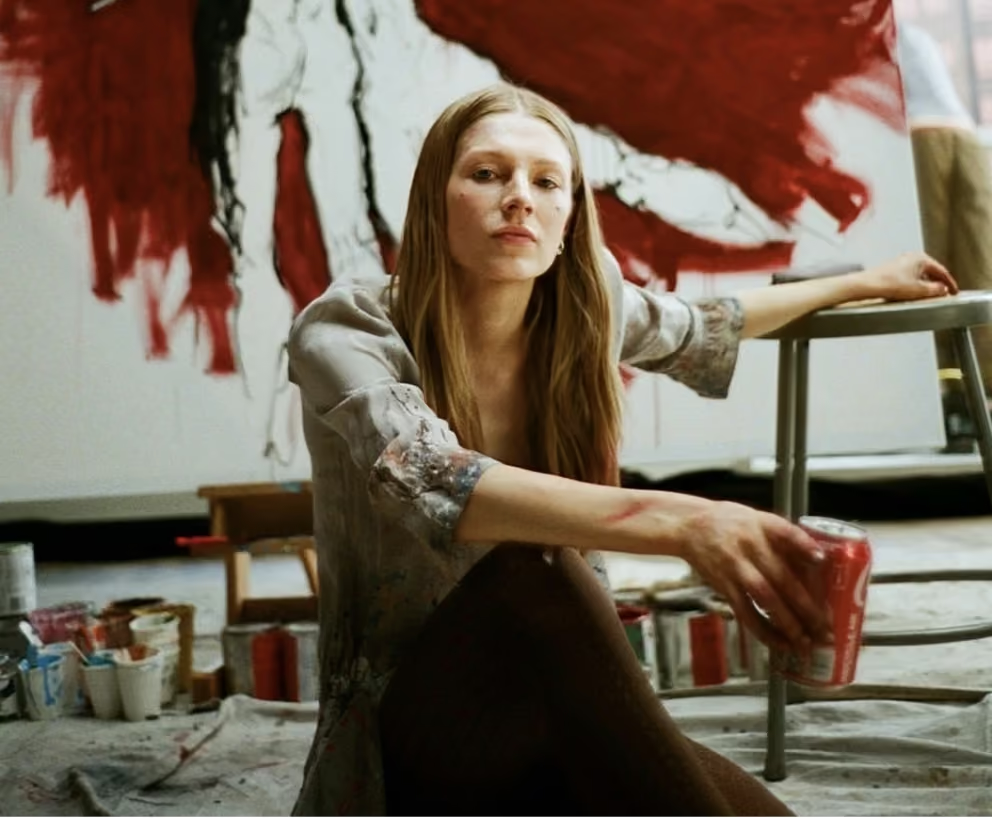
A trans lesbian’s reflections on desire and belonging in an unwelcoming world
In the 90s, the sapphics of West Hollywood began marching for lesbian visibility–topless in their dungarees and summoning dyke power. Now a fixture of the calendar in the 2020s, the theme of this year’s Lesbian Visibility Week is health and wellbeing. As a social worker, there is one cohort of lesbians whose health and wellbeing I think about quite often—my cohort: trans women lesbians.
I was talking to a dear friend of mine—another white trans woman I’ve known for nearly two decades. We were playing with Cora, her small and talkative ginger cat, illuminated by the lite brite of a computer screen and the spillover of hydroponic lamps. We were discussing the US government’s persecution of trans people and, of course, dating. We’re both lesbians with broad sexual interests. But whereas I am open to dating almost anyone, Cora’s mom very specifically prefers dating other trans women. “It’s the only time the mask can be off and I can relax.”
In my life and work, I find that trans women generally struggle to feel seen in our wholeness. We carry our experiences of transphobia–from rejection to rhetoric–and it instills a type of fear and hypervigilance that’s protective. Visibility itself can feel less like recognition and more like surveillance. To avoid it, we might find ourselves picking at our bodies beyond what is helpful or necessary to live in alignment with our gender. Other times we may disappear ourselves from places and relationships. Authenticity takes a back seat, possibility shrinks. It’s not all gloom and doom–we are so much more than our responses to cissexism–but it is a facet of trans womanhood that complicates observances like Lesbian Visibility Week.
Once upon a time, a trans woman lesbian was an oxymoron. Throughout the latter half of the 20th century, gender clinics required trans folks to conform to heteronormative desires to receive care. At that time, a trans person’s gender could only be deemed legitimate and actualized if they also desired to be heterosexual. This can be an underappreciated detail about how gender works culturally, at least in the United States. Even in a country with a pulse of gay liberation, gender and sexuality are still linked.
To be a woman is to desire (and be desired by) a man (and vice versa). Compulsory heterosexuality is inextricably gendered; binary gender is bound to heteronormativity. It’s why gay couples often face questions like “who’s the man?” This has been a barrier to trans woman lesbian experience for a long time.
In fact, as the lesbians of WeHo marched, Ray Blanchard was publishing his now-infamous typology of transexualism. In his writings, he propagated the idea of “autogynephilia” which reduces the sapphic desire of trans women to a Buffalo Bill style self-insertion kink. If a trans woman is interested in other women, it is from a narcissistic site of sexual self-gratification. It’s closer to creepypasta than it is to social science. Blanchard’s work has since been thoroughly debunked and rejected, but this distortion of how gender and sexuality manifest in trans women lesbians not only eclipsed a lived experience, but further propagated harmful myths about what intimacy with trans women means and negative stereotypes around trans women being sexually predatory, particularly in their relationship to cis women.
To varying extents, trans women lesbians carry these wounds, transmitted through a culture that reiterates these harms. It compounds on top of the usual ways lesbians struggle to validate their desires and identities. For trans women lesbians, questions about what type of intimacy is happening between two close women becomes complicated by the fear that our desire for women disproves our own womanhood or that we are being predatory for admiring and loving a woman.
Even as we can trace the lineage of these lies, I personally still find the threat of these projections quite visceral; they live on. Family members are confused to hear about my girlfriend. TERFs quote Blanchard. It doesn’t just exist in our heads. Trans women can face very particular exclusion in lesbian spaces.
Defensiveness around genital preferences by cis lesbians often leans on transphobia that sounds a lot like this history. Those of us who don’t pass as women to some aren’t given a lot of grace. A community that has fought to decouple identity from presentation suddenly glitches and a trans woman butch is collapsed into manhood against her will. It can be daunting to those approaching and exhausting for us on the other side.
In some ways, all of this is how I ended up spending time with Cora’s mom. It’s challenging to be well with all this on your mind, enough transphobia to stay safe but more than you’d like. It helps to be with someone who understands. It was just us two sprawled on beige carpet and watching a forever kitten tumble and chase and explore. Eating food grown from long hours of labor. Laughter and tears as loud and rhythmic as footsteps down Santa Monica Boulevard.
If you become a safe home for trans women like us, a person who understands, maybe we’ll show more of this to you. It was the most lesbian thing in all the world.
Looking for Support? The Expansive Group is Here for You.
Joy Belonger is a queer, transfeminine clinician interested in collaborative work where clients can be their complete selves. She aims to provide an encouraging and challenging space for folks to explore the meaning of gender identity, sexuality, and neurotype through an intersectional lens. If you’re interested in working with Joy, fill out our intake form. Joy practices therapy in Illinois and offers coaching anywhere
We have a diverse array of therapists on our site, all of whom affirm neurodiversity and multicultural identities, support sex-positive and non-traditional relationship structures, and are inclusive of queer and trans identities.
You can connect with one of our other therapists or coaches using our intake form. We offer individual and relationship support. In addition, check back regularly for support group openings where you can be in a community while healing.
Picture Credit: Euphoria